27 April 2026
|
Chris Ridge, Technical Director of the Thermal Insulation Contractors Association (TICA), explains why we cannot afford to treat thermal insulation as an afterthought and lays out a pathway for industry collaboration that could make a real and lasting difference.
TICA represent specialist contractors who insulate and clad pipework, ductwork and associated equipment. TICA members do not typically insulate commercial refrigeration services such as VRV/VRF pipes, and any issues related to commercial refrigeration installations were previously not on our radar. This all changed in early 2025 when I was approached by Lawrence Leask FInstR, an Air Conditioning Inspector with a lot to say about thermal insulation!
Lawrence was able to provide clear evidence that thermal insulation was often failing within months of installation on many commercial refrigeration projects. It soon became clear that whilst the solutions were available, there was a real lack of awareness about the actual problem. We resolved to raise awareness and encourage collaboration, and with the help of the Institute of Refrigeration, we began to build a bridge between our trades.
Raising awareness
So, what is the actual problem?
The standard practice is for refrigeration contractors to insulate refrigeration pipes with flexible foam products such as flexible elastomeric foams, (commonly referred to as “nitrile rubber”). Standard nitrile rubber products are suitable for internally located applications but is not suitable for external locations. Weather and UVresistant alternatives are marketed but rarely utilised.
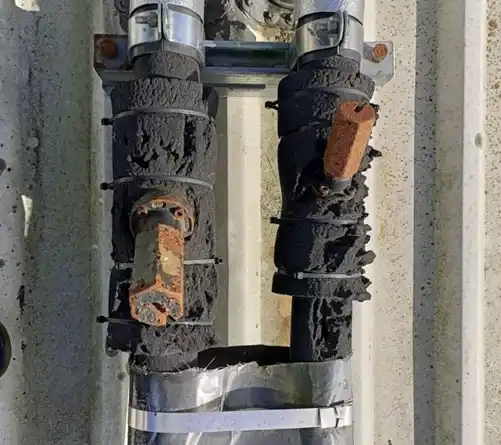
Installing non-UV resistant flexible foams in external locations can result in embrittlement and degradation of the material – a process that can start within days of the installation.
The first sign of the insulation breaking down can be seen when the outer layer loses its smooth texture and starts to become brittle. As the insulation degrades, it loses its closed-cell structure and starts to absorb moisture, effectively turning into a sponge.
Degradation of the pipe insulation will lead to increased energy costs and increased operational carbon. Saturated insulation will also increase the risks of corrosion under insulation. Ultimately, clients are left with an inadequate installation that can only be rectified with an additional financial and embodied carbon cost. However, rooftop services are often “out of sight, out of mind” and unlikely to be rectified during the lifetime of the installation.
There is no single point of failure in the supply chain, and awareness needs to be raised throughout the contractual route to avoid expensive mistakes occurring. Building Services Consultants and Contractors need to be clear in their specifications for externally located insulation. Specialist Refrigeration Contractors need to ensure that they are installing suitable products. Finally, manufacturers and distributors need to work together to make sure that weather and UV-resistant systems are easily accessible when required.
More emphasis also needs to be placed the condition of pipe insulation during TM44 Air Conditioning Inspections. Has the inspector checked whether the insulation is UV-resistant or if it has begun to embrittle due to UV damage and weathering?
The system
More thought needs to be given to the overall system of insulation. How is the insulation supported and fixed? It is common to see refrigeration services cable tied together. Cable ties can strangle the insulation and reduce thermal performance. Cable ties can also cut into the insulation, aiding the embrittlement process.
The pipe supports also need to be considered. Common practice is for rubber lined clips or cushion clamps to be installed direct to pipe. Neither of these methods can promote a complete vapour seal and will promote water ingress.
Most manufacturers of nitrile rubber products also market matching insulated pipe support inserts to help maintain a complete vapour seal through the pipe support. Whilst these offer an improved solution, some products may not be UVresistant and manufacturer guidance is recommended.
Ongoing inspection cycles
As the name suggests, UV-resistant thermal insulation offers greater resistance to UV damage – but this does not make the insulation UV-proof.
Inspection cycles will still need to be in place, even if the risk of degradation is far lower. The standard of insulation is reported with the CIBSE TM44 inspection every five years. However, it is only reported as ‘good or bad’ and there is no further guidance. Where it is suspected that non-UV-resistant flexible foams have been used, an immediate intermediate inspection should be carried out on the externally located insulation.
The five-year cycle leaves ample opportunity for non-UV-resistant insulation to break down and start losing heat from the pipe. Humid air can then reach the surface of the pipe and condensate, leading to corrosion, ceiling damage and mould growth.
Even insulation protected with a professionally installed external cladding system can be susceptible to damage. Any weak point in the system could lead to water ingress and the potential for corrosion under insulation, so there is always a need for ongoing inspection. The danger of damage from wildlife should also be considered in the maintenance cycle. Have additional measures been taken to protect the installation from winged wildlife (e.g. bird netting)? If the answer is no, then it is unlikely that the installation will last it’s expected lifetime, even if it is UV-protected and correctly vapour sealed.
Providing clarity
In all cases other than commercial refrigeration applications (i.e. Dx and VRV/ VRF applications) and domestic applications, a specialist Thermal Insulation Contractor (TIC) should be appointed.
Why is the commercial refrigeration industry different to other related industries in this regard? Essentially, it’s because insulation of commercial refrigeration systems can typically be accomplished using flexible foam pipe insulation products that do not require the same level of installation skill as rigid foam products.
However, when thermal insulation is considered as a peripheral concern rather than the key focus, there is always potential for a knowledge gap to exist.
TICA have worked closely with the IOR to support new technical bulletins and guides and effectively help close the knowledge gap. The new version of BS 5970 (Thermal insulation of pipework, ductwork, associated equipment and other industrial installations in the temperature range of -100°C to +870°C. Code of practice) will also provide more clarity.
The need to clarify responsibilities is important. For example, industrial refrigeration and cold store installations absolutely require the appointment of a competent TIC. In a similar vein, single domestic heat pumps are typically insulated by the heat pump installer, but all communal and commercial heat pump installations require the appointment of a TIC.
Installation TIC Required?
Domestic Heat Pumps * NO
Communal Heat Pumps YES
Commercial Heat Pumps YES
Commercial VRX/VRF/DX* NO
Industrial Refrigeration YES
Working together
Everyone has a part to play if we are to promote good practice on commercial refrigeration installations. For TICA’s part, we just hope that we can offer some insight based on the pitfalls faced by our own specialist contractors.
This is a systems problem, and we need to align the goals of consultants, M&E contractors, refrigeration contractors, distributors and insulation manufacturers with the energy saving goals of the client.
We should also consider the role of the plant manufacturers. Manufacturers of air conditioning and heat pump systems can often boast of improved efficiencies for their manufactured products, but perhaps they can be encouraged to engage on the efficiencies of the entire system and play a part in the bigger picture? I believe that equipment manufacturers could make a positive difference if they were to specify a suitable thermal insulation system for use with their products – this could have a far bigger impact than any incremental motor efficiency gains!
Chris continues to work with Lawrence Leask to build a bridge between the commercial refrigeration and thermal insulation industries most noticeably through “The Proof is on the Roof”. The primary purpose of this initiative is to “challenge the whole industry to address the enormous energy losses occurring because of badly insulated pipework on our rooftops, in our plant rooms and other easily forgotten spaces in our buildings.