29 April 2026
|
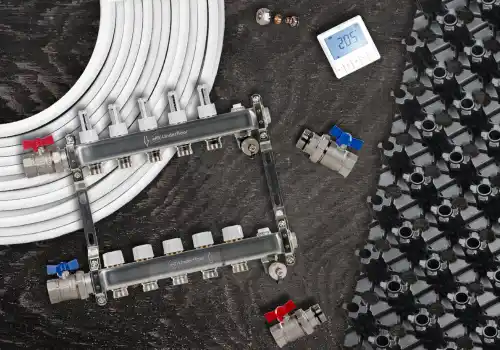
Driven largely by the need for greater levels of efficiency, underfloor heating (UFH) is not only a viable alternative to traditional heating methods, but it is also now one of the fastest-growing sectors of home heating.
In the UK, 22% of all emissions are generated by homes, with heating systems accounting for a significant share of this. As the government continues its push towards net zero 2050 and prepares to implement the Future Homes Standard in 2028, specifiers need to consider heating systems early in the design phase, and one system that can help us achieve those ambitions while also bringing greater comfort, aesthetics, and functionality to modern living spaces is UFH.
As an increasingly familiar feature in new build housing, Sam White, Technical Sales Engineer for RWC, explains why specifiers should consider using UFH systems when designing low-energy homes for the future.
Accelerating the shift to low-temperature heating
Recent updates to Part L and Part F of the Building Regulations were designed to improve energy efficiency in new homes, reduce carbon emissions, and support the transition to low-carbon heating.
A key requirement is that new homes must be designed to operate efficiently at lower temperatures, with heating systems sized for a maximum flow temperature of 55°C. This approach naturally supports the growing adoption of low-temperature renewable technologies, such as heat pumps, and helps ensure homes are future-ready. As a result, heating systems that perform efficiently at low-temperatures – such as underfloor heating – are particularly well suited to meeting these requirements.
Alongside these regulatory updates, the Future Homes Standard (FHS), which will apply to all new homes from 2028, will push energy performance requirements even further. The FHS introduces significantly tighter carbon and energy-efficiency targets for new homes, setting performance standards that strongly favour low-carbon heating solutions and effectively phase out the use of gas boilers and other high-carbon heating systems in new build developments.
It is clear that ensuring low operating temperatures for heating systems is a key part of the UK’s journey to improving energy efficiency in homes. As a solution that operates efficiently at much lower temperatures than radiators, works seamlessly with heat pumps, and will help homes to achieve FHS carbon reduction benchmarks, underfloor heating can play a key role in helping homes meet future carbon-reduction and performance targets.
Why underfloor heating is the smart choice
With heat pumps set to become one of the more dominant heating system in new build housing, emitter selection has never been more important. Here, UFH offers a compelling solution for delivering energy-efficient, comfortable and space-saving homes.
Not only does operating at a lower temperature than radiators make UFH an ideal partner for heat pumps, but it also allows heating systems to operate more efficient from day one - by up to 25%, depending on system design and operating conditions.
When paired with a sustainable heat source technology, such as heat pumps, these gains can be even greater, with efficiency improvements of up to 40%, helping development projects to meet increasingly stringent carbon and energy performance targets.
The lower operating temperatures of UFH also leads to more stable and comfortable heating. Typically, radiators need to rapidly heat up to temperatures of around 65°C, often creating sharp temperature fluctuations that can be inefficient and uncomfortable for the homeowners. In contrast, UFH operates with only small temperature variations and provides a gentle and consistent level of warmth.
This is because UFH delivers radiant heat that starts from the floor and rises throughout the room, to create an even warmth and a comfortable environment free of cold spots and draughts.
This even heat distribution also helps to reduce air stratification and reduces dust circulation, supporting a healthier indoor environment - an increasingly important consideration during as wellbeing becomes a priority in modern housing design.
Lower flow temperature also places less stress on the heating system components, which can help extend the system lifespan and reduce the overall energy demand. Both factors are important when evaluating the whole-life cost rather than just initial installation.
From a usability perspective, UFH works quietly in the background to maintain a consistent indoor temperature, and by using the controls or smartphone app, homeowners can adjust heating schedules easily, ensuring warmth is delivered when and where it is needed most. For even greater flexibility, zoning capabilities give homeowners individual control over the temperature in every room, so heating and energy bills are not wasted on unused rooms.
Architecturally, UFH provides greater design freedom. Rather than being attached to the wall and potentially obstructed by furniture, as radiators often are, UFH and its pipework are invisible under the floor, and core elements such as the manifold can be hidden discreetly in cupboards. This transforms the aesthetics and functionality of living spaces and allows homeowners to configure rooms just how they like without being restricted by visible heating elements.
Although UFH requires an upfront investment, noticeable improvements in operating efficiency enable homeowners to realise tangible savings on their heating bills over time. Alongside that, a host of benefits - from comfort underfoot through to improved indoor air quality, to improved aesthetics - make underfloor heating an increasingly attractive option for modern homes.
An ideal partner
For decades, radiators have been a familiar fixture in homes. However, as sustainability climbs higher on the agenda and low-carbon technologies such as heat pumps grow in popularity, there is a clear argument for why underfloor heating is a suitable option for helping heat the next generation of homes.
For specifiers, this shift presents an opportunity to design heating systems that operate efficiently at lower temperatures, support wider decarbonisation goals and integrate seamlessly with modern controls. Engaging manufacturers early in the design process can also help ensure system compatibility, effective zoning and optimal performance, which are all critical for achieving a highly efficient whole-system approach.
Recognising the growing demand for flexible, performance-led solutions, JG Underfloor has expanded its range of underfloor heating systems to support a variety of project requirements and budgets. Their enhanced Push-Fit system, featuring push-fit manifolds and Layflat Polybutylene Pipe for straightforward connection, has been developed to provide a more cost-efficient installation while maintaining high performance and reliability.
For projects where budget efficiency is key, their Euroconus Manifold with PERT pipe provides a value-engineered alternative delivering dependable and consistent heating performance. Both systems are compatible with JG Underfloor pipe fixing solutions for screed, timber and low-profile floor constructions, enabling warm water to be distributed evenly through the pipe circuits to provide comfortable, consistent heat throughout the home.
The systems are also designed for straightforward installation and can be combined with their Underfloor Heating Controls to enable independent zoning across individual rooms, helping homeowners manage comfort while avoiding unnecessary energy use.
As heating strategies continue to evolve towards lower-carbon solutions, specifiers should ensure that the systems they select deliver compliant, future-ready performance for the next generation. With low temperature and flow rates, zoning capabilities and seamless integration with heat pumps, underfloor heating is the smart choice for new homes.
To celebrate the expansion of its range, until the 31 May, JG Underfloor is offering specifiers and tradespeople the chance to win an underfloor heating system worth up to £5,000.
To find out how to enter, visit: www.johnguest.com/ufh-giveaway. (T&Cs apply).