25 February 2026
|
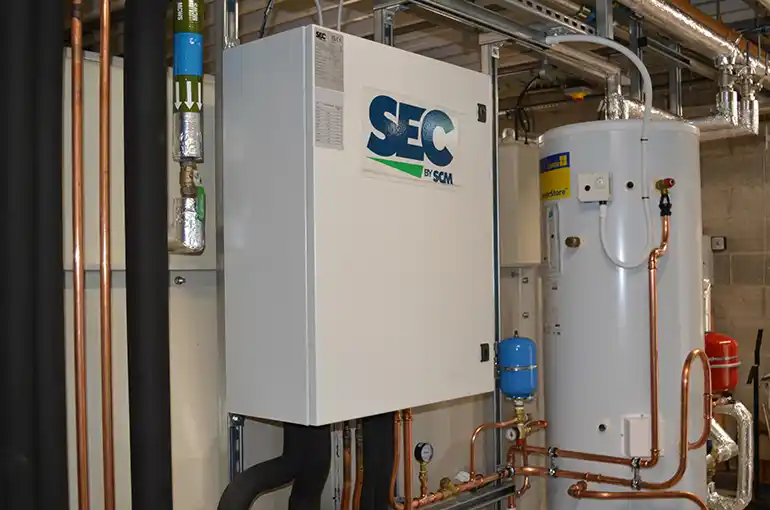 Solutions such as the Sustainable Energy Controller (SEC) make heat recovery part of the wider system through active thermal management
Heat recovery from refrigeration has long been limited by operating hours and system design. Lee Downham, Group Support & Design Director at Beijer Ref UK & Ire, discusses how newer approaches are extending recovery beyond active cooling, allowing rejected heat to contribute more consistently to hot water demand.
Recovering waste heat from refrigeration and air conditioning systems has been discussed within the HVACR sector for decades. In practice, however, it has remained marginal. In most commercial applications, heat recovery is tied directly to the operating profile of the refrigeration plant. When compressors are running to satisfy a cooling demand, rejected heat is available. When they stop, it is not. Hot water production then falls back on gas or electric systems. This mismatch between cooling demand and heat demand is one of the main reasons heat recovery has struggled to move beyond limited or specialist use.
That limitation matters more now than it did in the past. Energy costs have risen sharply, and decarbonisation targets are becoming harder to ignore. The International Energy Agency estimates that heating and hot water account for around 40% of final energy consumption in commercial buildings across Europe. Refrigeration, meanwhile, can represent between 30% and 50% of electricity use in food retail and hospitality settings. These demands often exist in the same buildings, at the same time. Yet they are still typically served by separate systems. From an engineering point of view, that is inefficient, particularly when large volumes of low-grade heat are being rejected to atmosphere while water is being heated elsewhere on site.
Rethinking the relationship between cooling and hot water
Traditional heat recovery solutions are usually straightforward in concept. Most rely on desuperheaters or coil-in-tank arrangements connected to the discharge line of the refrigeration system. Under steady conditions they can work well enough. The problem is that they are passive. Heat is only recovered when the refrigeration plant is operating, and there is limited control over how much heat is transferred or when. As soon as cooling demand drops, recovery stops. In buildings with variable loads or intermittent operation, this can significantly reduce the overall contribution heat recovery makes to hot water demand.
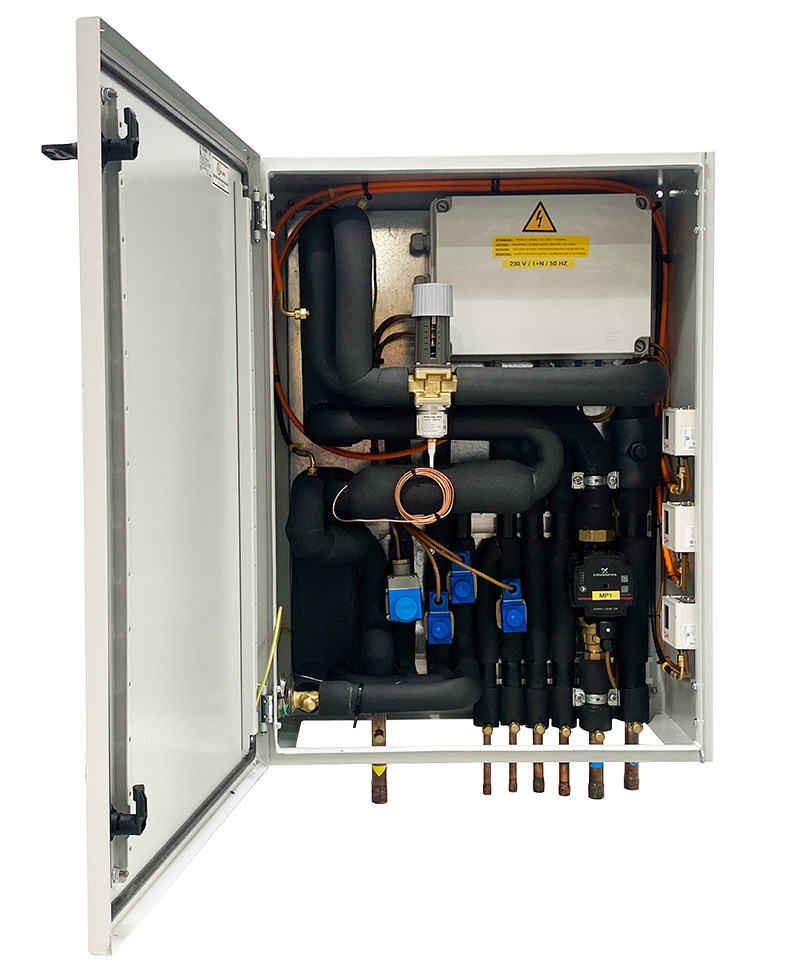
More recent developments are trying to address that weakness. The shift is away from passive recovery and towards active thermal management. Rather than being treated as a bolt-on, heat recovery becomes part of the wider system. These solutions sit between the refrigeration plant and the hot water system and manage energy flows based on demand on both sides. One example is the Sustainable Energy Controller, developed by SCM Frigo and deployed in the UK by Beijer Ref. The aim is not to generate more heat, but to make better use of the heat that is already there.
Extending recovery beyond active cooling
The main technical difference with this approach is the use of multiple operating modes. During normal refrigeration operation, heat is recovered in the traditional manner, using dedicated plate heat exchangers rather than coils inside storage tanks. This improves heat transfer and gives better control over water temperatures. That becomes important where higher or more stable hot water temperatures are needed.
The real change comes when cooling demand reduces or stops. In a secondary mode, residual heat stored within the refrigeration system is actively harvested. Compressors, pipework and heat exchangers retain thermal energy after a system cycles off. In most installations, that heat is simply lost over time. By transferring that residual energy to the water circuit, additional heat can be recovered without increasing electrical input. On systems that cycle frequently, the effect is noticeable when viewed over weeks or months rather than hours.
A further step is taken when there is no cooling demand at all, but hot water is still required. In this situation, the refrigeration system can be operated as an air-to-water heat pump. Low-grade heat is drawn from the ambient environment through the existing outdoor heat exchanger and upgraded to useful temperatures. Hot water production is no longer dependent on cooling demand. For applications such as hospitality and food production, where hot water demand often extends well beyond refrigeration run hours, this represents a clear departure from traditional heat recovery.
Control, refrigerants and real-world performance
This type of operation relies heavily on control. PLC-based platforms manage valves, pumps and compressors across the different modes, keeping the system within safe operating limits and ensuring refrigeration performance is not compromised. In most standard installations, control parameters are pre-configured to suit typical system layouts. There is still scope for adjustment where site conditions require it. From an installer’s point of view, that matters. It reduces commissioning time and limits the risk of errors during setup.
Refrigerant choice is another factor. As the industry responds to F-Gas regulation and the Kigali Amendment, heat recovery systems need to operate across a range of refrigerants. That includes HFCs, HFOs and natural options such as CO₂. European Commission data shows that F-Gas emissions fell by around 25% between 2014 and 2022, largely due to refrigerant transition. At the same time, there is growing recognition that improving system efficiency and reducing indirect emissions through energy recovery must run alongside refrigerant change, particularly as availability tightens.
Performance needs to be judged on measured results rather than claims. Independent studies suggest that effective heat recovery can offset between 60% and 100% of a site’s hot water energy demand, depending on how the system is used. In the UK, each kilowatt-hour of electricity displaced by recovered heat avoids roughly 0.18kg of CO₂e, based on current grid carbon intensity. Over a year, even small systems can deliver carbon savings measured in tonnes.
Where this approach fits in the wider decarbonisation picture
Operational data from food production and hospitality sites shows annual energy savings typically in the range of 8,000-25,000kWh for small to medium refrigeration systems. When installation costs are considered, payback periods of two to three years are common, although this varies with usage patterns and existing plant. For many operators, that places advanced heat recovery within acceptable investment limits, particularly where projects also support wider sustainability targets.
Although supermarkets and bars are often cited first, the principles apply more widely. Food processing facilities are a good fit, as refrigeration and wash-down hot water demands overlap. Agricultural sites with chilled storage can reduce dependence on fossil-fuelled water heating. Pharmaceutical and medical storage environments can improve energy performance without affecting temperature control. There is also increasing interest in mixed-use commercial buildings, where refrigeration, air conditioning and hot water loads interact in less predictable ways.
What stands out is that the benefit lies less in any single component and more in how these systems encourage a broader view of energy use. CIBSE and the International Energy Agency have both pointed to the need for better integration of existing technologies if meaningful carbon reductions are to be achieved in the built environment. Heat recovery on its own will not deliver Net Zero buildings. That said, moving from intermittent, passive recovery to continuous, actively managed use of rejected heat is a practical step. For an industry that has long accepted heat rejection as unavoidable, it represents a shift in thinking as much as a change in technology.