10 December 2025
|
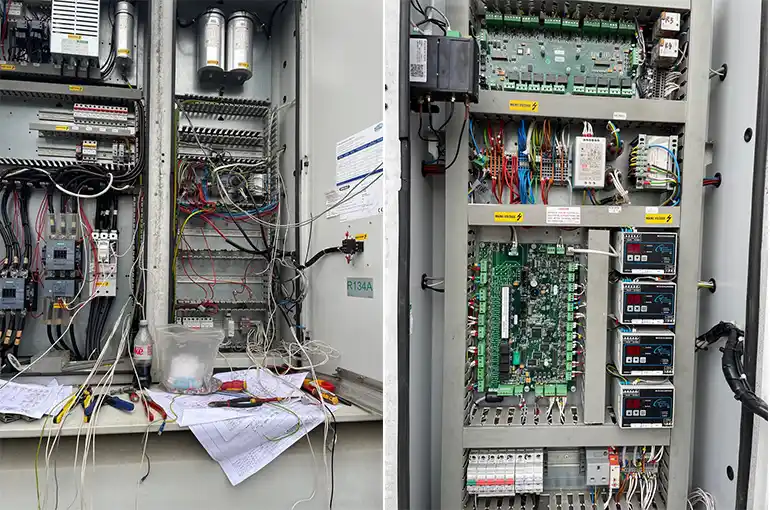

Trevor Dann, Technical Director of ThermOzone, explains the benefits of a retrofit solution to controls failure.
One of the most common service issues with a cooling chiller is service interruption due to controls failure. This can manifest as a direct electrical or electronics failure, general chiller unreliability, lack of manufacturer support, or simply obsolescence and old age. Occasionally a compressor motor failure can lead to a back surge via the motor protection circuit, compounding an initial problem.
Problematic issues with chiller control systems are surprisingly common, but often a difficult problem to resolve. Most control systems are either maker-specific or generic ‘locked', eg a separate controls maker provides the controller, but the access and support is restricted by the chiller manufacturer. This then requires direct manufacturer support, which is both expensive and often protracted.
For example, we had an emergency project (we will call it “Savile Row”) to completely replace the controller on two chillers simply because the manufacturer was quoting some three months for new controller parts. We understand the chiller failed after a heavy electrical storm, so it looked like the equipment had taken a lightning strike. This had rendered both chillers unserviceable, not an ideal situation in late June!
Invariably chiller control problems are compounded by the investigating engineers having no clue as to where to start. As a result, false diagnosis is common, so fixing the issue becomes a ‘change this, no that didn’t work; OK let’s try that!’ As such, the engineer and his/her firm are on a hiding to nothing and by the third fix attempt their credibility is being questioned. Such a haphazard approach is also undefined regarding both timescale and costs. Indeed, the firm applying the fix attempts will expect to be paid, but the Client funding the repair might be miffed that the equipment is at best still unreliable, or worse simply still not working. Not an ideal commercial situation.
Retrofit approach
The thought of literally ripping and cutting out vast quantities of wires and junking numerous control components from inside a control panel can seem very daunting. Let alone the task of replacing the hardware and achieving a safe and proper functionality.
However, taking this to basics allows us to consider each chiller as a blank panel: so simply a group of standard chiller components requiring a means to turn on compressors, control the refrigeration cycles, control condenser fans and sometimes the associated pumps etc.
In this regard, even the most complicated chiller has simply a whole array of parallel electrical circuits working in harmony, and generally the whole lot is coordinated by a single dedicated control system.
When this approach is taken the original complex problem gets broken down into a series of manageable aspects:
- Accurate control of the primary function
- Control of the compressor start/stop via the original switchgear (contactors and/or inverters)
- Control of multiple sub-systems or circuits
- Control of the condenser cooling fans
- Control of associated pumps (where not on external plant control)
- Time scheduling
- Sub-system rotation
- Coordination with external control demands such as the Building Management System (BMS).
Once these key elements are considered a control strategy re-design can also pay attention to:
- Flow and freeze protection
- Refrigerant optimisation and choice - energy efficiency and environmental concerns, eg Global Warming Potential
- Improvement of chiller operating efficiency: eg conversion to inverters
- Improved off cycle operation
- Power supply monitoring and protection against loss of phase
- Remote access and support, including fault alert via email
Some of these, eg inverter or refrigerant retrofit, will incur greater cost and downtime, but conversely for most projects modification to inverter will offer an attractive return on investment, certainly within three years and sometimes within one year.
The approach we apply when reviewing a fresh potential project is how many systems and what is the general status of the controls as found.
Are there any clear safety issues – loose unconnected wires; system/compressor failures; lack of panel door safety interlocks – typically ~ 90%+ of all the chillers out there have had the panel door isolator safety interlock disabled – it is there for a good reason!
Savile Row project, June 2024
We were contacted by an established customer but for a site we are not familiar with because both air-cooled chillers have failed on their controllers, which arose following an electrical storm. A site visit the following day revealed both controllers completely non-responsive, hence an expensive commercial building with tenants paying premium rents has been left with no cooling, and incidentally very few opening windows! This whole issue was made worse by the OEM advice of three months’ delivery for the necessary controls parts!
Hence very unhappy tenants threatening withholding of premium Mayfair area rental payments. Hardly surprising as it was stifling at >30°C throughout most of the offices.
We quickly assessed the chillers – simple dual circuit air-cooled units each with two scroll compressors, so 4 step stages of cooling. All the compressors were tested and found functional. There were also electronic expansion refrigeration control valves (EEVvs), but their sub-controller drivers were also non responsive as these were integrated into the main controller electronics – a common Italian make, but ‘locked’ to the setting preferences of the chiller manufacturer – so not even the controls makers agents could directly assist without the chiller’s strategy, to which they had no access.
We offered a package of new controller with service interface keypad, input/output expansion to provide up to 32 input channels, 20 output channels and 4 analogues outputs for the fan controller and EEVvs. Supplementing the package was a full array of new pressure, temperature and current sensors, plus a dedicated strategy configuration to suit the overall application.
Our priced proposals were offered the following day and as these are routinely available sub-assembly components, we were instructed the commence the day after that. We had provided an estimate of ~ two weeks to achieve first start-up, so some 10 weeks better than offered by the OEM.
Our works at the site commenced on a Thursday, we worked over the weekend and achieved start-up of the first chiller by the Tuesday of the week following. So, after just six days cooling was restored, and we then paid attention to the second chiller. The second was operating the following week, so less than two weeks from instruction to full-service restoration.
As part of the first chiller start-up, we also established remote access via the RODEM system and 4G mobile phone network. RODEM not only allows us to access and view, but to pro-actively adjust and monitor service 24-7. This set-up also tells us when a fault arises via email. Indeed, we know of a chiller issue before the client, and invariably (>85%) we resolve faults without a site visit just by applying a few adjustments.
This >85% fault resolution remotely enacted remains the norm longer term, with projects up to 10 or 12 years old still offering minimal call out, zero compressor failure (yes zero compressor failure on any project!), and well-established system reliability and confidence.
For most typical chillers undergoing a controls (heart) transplant we expect to achieve system operation within a week to 10 days.
None are that complex, although most will have a unique aspect of how to achieve best mode of control to consider and resolve, for instance the latest one under our jurisdiction has the chiller acting as a slave system with multiple start inputs each directly starting a compressor/sub-system.
So, if you have unreliable chillers suffering seemingly never-ending control problems then why not consider a defined and warranted solution. A site assessment and detailed proposal costs nothing.