17 December 2025
|
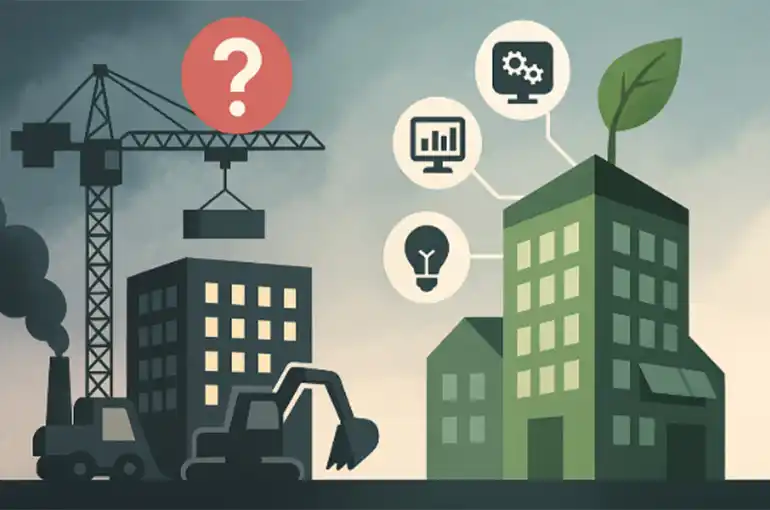
Energy-efficiency specialist Exergio says the picture for green buildings is getting weaker, following publication of the Royal Institution of Chartered Surveyors (RICS) 2025 Sustainability Report.
Demand for sustainable real estate is said to be cooling in most regions, with many projects stalling over high upfront costs and uncertain payback, and almost half of construction professionals still don’t measure carbon on their projects – a share that has actually grown over the past year.
Exergio, a company developing AI tools for energy efficiency in real estate, says the sector is stuck not for lack of ambition but because three systemic failures – stalled demand, unclear financial value, and weak operational follow-through – remain unresolved.
Donatas Karčiauskas, CEO of Exergio, adds that without scalable, AI-driven optimisation of day-to-day operations, even certified or renovated buildings will keep missing climate and performance targets.
Global demand for sustainable buildings has been sliding for several years now, with the RICS report showing another drop from 41% to 30%. Investors and developers mostly blame unclear returns: 35-46% cite uncertain ROI, payback periods or operational savings as their main barrier to investing.
“Investors aren’t against building sustainably – they just need proof it pays back. If a project requires expensive materials, equipment and certifications but the real-world performance doesn’t translate into measurable savings, why would anyone scale it? Until buildings can demonstrate clear, verifiable returns, demand will keep sliding,” said Donatas Karčiauskas.
Using AI to optimise existing systems, Exergio says it typically cuts energy use in large commercial buildings by up to 30% and that translates to more than €1 million in annual savings – the kind of proof investors are looking for. But money isn’t the only problem, the report shows.
The RICS data reveals a growing split between what occupiers value and what investors prioritise. Occupiers favour performance – 94% cite indoor environmental quality and 88% name energy efficiency as top priorities – while investors still focus on certification (86%) and resilience features (78%).
The market talks about sustainability as if it were one thing, but in practice, different players are chasing different goals, according to Karčiauskas.
He said: “Occupiers care about how a building works; investors care about how it’s labelled. Until performance and certification point in the same direction, we’ll keep building assets that look sustainable on paper but don’t deliver it in practice. The real solution is to measure what happens inside the building, every day – that’s when both groups finally get what they’re paying for.”
The RICS report shows that this kind of measurement is still the exception, not the rule. Across regions, roughly half of respondents don’t measure embodied carbon at all, and only about 16% say their assessments change design choices. Just 17% believe the industry has enough sustainability knowledge, and only 10% are very familiar with whole-life carbon methods.
Karčiauskas believes this is because the respondents do not know how to measure the emissions: “You can’t improve what you don’t measure, and you can’t measure what you don’t have the skills to assess. Right now, most carbon decisions are built on assumptions instead of real evidence.”
In his opinion, the combination of missing carbon data, limited expertise, and inconsistent measurement is precisely where AI can accelerate progress. AI systems can gather performance data automatically, interpret it without specialised training, and adjust building systems continuously – something human teams cannot do at scale.
He added: “AI closes the gap the industry can’t close on its own. It proves ROI with real performance data, aligns what occupiers want with what investors pay for, and automates optimisation that today requires scarce expertise. If we want sustainability targets to become real outcomes, this is the only lever big enough to work at scale.”