10 December 2025
|
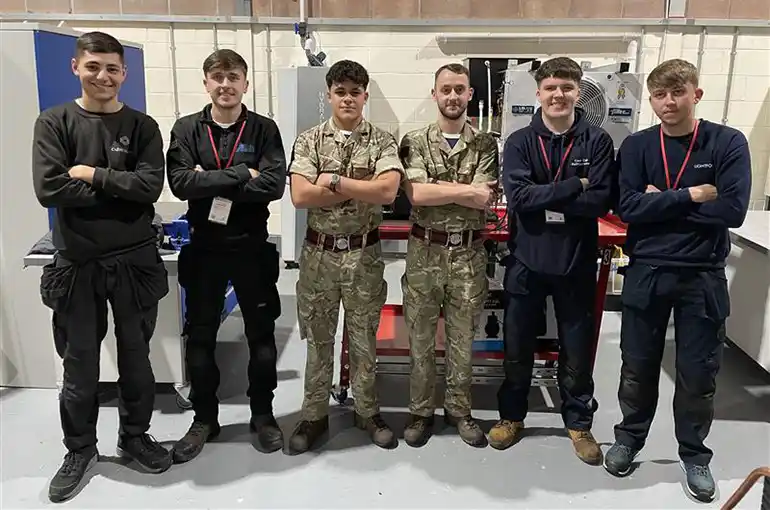 WorldSkills UK winner Isaac Jervis, third left, with fellow finalists, from left, Taylor Mclaughlin, Sam Jones, Daniel Hunt, Craig Gow and Evan Jones
The Building Engineering Services Association (BESA) is urging military engineers transitioning to civilian life to consider becoming trainers, assessors and building safety auditors.
With engineering and construction-related businesses reporting shortages of suitably trained people able to fill their widening skills gaps, BESA is reaching out to Army leavers in a bid to address the critical shortage of apprenticeship trainers and assessors that continues to undermine the delivery of building services courses.
It is urging them to consider signing up to BESA’s fully funded Skills Legacy programme which was launched this year with the aim of recruiting 100 trainers and assessors to help further education (FE) providers deliver more building services apprenticeships.
BESA’s nationwide scheme is bringing together employers and training providers to create a pathway for anyone with the right skills, experience and qualifications to become a trainer or assessor qualified to a Level 3 Certificate in Assessing Vocational Achievement (CAVA).
It will also train engineers to become qualified building safety auditors in line with the ISO 9001 management standard to help the industry cope with new competence requirements created by the Building Safety Act.
“68% of UK employers struggled to find skilled workers in the past year, with the shortfall costing businesses a collective £4.4 billion,” said BESA’s Head of Competence Stuart Rattray. “Yet there is an often-overlooked solution hiding in plain sight in the shape of highly trained people leaving our armed forces.
“They represent a rich and largely untapped pool of skilled, dedicated professionals who bring with them a wealth of transferable skills, discipline, and a proven ability to thrive in high-pressure environments.
“However, as well as being ideal direct recruits into the built environment workforce, they can also be rapidly re-trained to help our colleges deliver more of the specialist courses we so desperately need.”
Army leavers have a range of technical and leadership skills developed in challenging situations which gives them the attributes needed to become trainers, assessors and building safety auditors.
They are used to working under pressure, adapting to new technologies and environments quickly, and delivering results against tight deadlines – and, while many can be recruited directly into the sector’s workforce, BESA is keen to encourage others to focus on training up the next generation of building engineers.
Two members of the Royal Corps of Engineers reached the final of this year’s WorldSkills UK refrigeration, air conditioning and heat pump section, which is organised by BESA, with one of those, 18-year-old Isaac Jervis, going on to take the gold medal.
The six finalists were challenged to demonstrate their skills and knowledge in testing ‘real world’ situations, including pipework installation, electrical testing, pressure checks and controlled refrigerant handling. They also commissioned systems for optimal efficiency and performed environmentally responsible refrigerant recovery, demonstrating their ability to manage the entire lifecycle of a working system.
Jervis was the youngest finalist and scored well over 90% in all the combined elements of the competition. Samuel Jones, representing the Practical Refrigeration Training Centre and Industrial Cooling Equipment, took the silver medal with bronze going to Craig Gow, Glasgow Kelvin College / Cool Cair Refrigeration.
Evan Jones, City of Portsmouth College and Lightfoot International, was highly commended and the other two finalists Taylor Mclaughin of Cubic Works and Daniel Hunt of the Royal Engineers also received high praise from the panel of expert judges.
Finalists under 21 years of age who scored above average will also be considered for the UK’s international squad preparing to compete at the 2028 Skills Olympics in Aichi, Japan.
A pre-registration test for next year’s WorldSkills UK competition is already available for learners to complete at work or in college. A tutor, mentor, or workplace supervisor can mark the test, and anyone achieving over 60% is encouraged to enter the 2026 programme. Click here to apply.
- The Manly Charitable Trust is co-sponsoring BESA's Skills Legacy scheme and is committed to funding the first 50 participants. Founded in 1991 by former BESA President Graham Manly in memory of his father Alfred Manly, the trust provides financial assistance to charities that provide opportunities for young people in STEM (science, technology, engineering and maths) and help advance engineering education.