12 March 2026
|
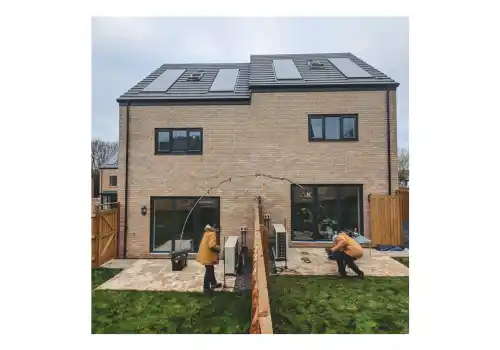
Members of a research team within the Acoustics Research Centre at the University of Salford, and part of the Future Homes Acoustics team, share their findings from investigations into improved methods for the noise management and assessment of air source heat pumps (ASHPs).
Air Source Heat Pumps (ASHPs) have the scope to play a central role in decarbonising the UK’s housing stock. As deployment accelerates, however, concerns about noise are increasing. While thermal performance is well understood, the acoustic implications of large-scale adoption (particularly for planning approval and community noise annoyance) remain a challenge.
To address this, a research team within the Acoustics Research Centre of the University of Salford has spent the past three years investigating improved methods for ASHP noise management and assessment. This work forms part of Future Homes, a flagship project led by Energy House Labs and supported by £3.5 million funding under the Innovation Accelerator programme of Innovate UK (project number 10054845) and the Greater Manchester Combined Authority.
The project unites academia (the Universities of Salford and Manchester) and industry partners (including Barratt Developments, Bellway Homes, and Saint Gobain) to accelerate low-carbon housing innovation. The acoustics team has also worked closely with organisations such as the Heat Pump Association to address noise-related barriers to ASHP adoption.
Through Future Homes, Salford Acoustics1 has access to a unique research ecosystem for studying sustainable housing. A key facility is Energy House 2.0, which contains full-scale homes within a climatic chamber operating from −20 °C to +40 °C. This setting allows
detailed acoustic measurements without interference from wind or traffic noise, which can otherwise mask important features of ASHP sound.
Complementing this work, Salford Acoustics also uses its UKAS-accredited Acoustics Laboratories. These facilities support both standard testing and bespoke studies in vibration, environmental noise, and human perception, allowing ASHP noise assessment by human experience as well as sound levels.
Overview of research work
Our research aims to address noise challenges in ASHPs to support uptake. Key activities include:
- Noise characterisation: improved measurement protocols considering directionality, tonality, placement, and cumulative effects.
- Mitigation strategies: assessment of common fences as noise barriers.
- Planning optimisation: a CIBSE-funded PhD project focuses on minimising community noise impact through better ASHP placement.
- Stakeholder engagement: hosted a UK-wide ASHP Noise Policy Workshop (July 2025).
- Industry collaboration: published a field assessment report with the Heat Pump Association (Sept 2025) and launched an engineer survey on sound and vibration (Nov 2025).
- International leadership: leading psychoacoustics research under IEA HPT Annex 63, coordinating a pan-European study on:
- Tonality and low-frequency effects
- Impact of background noise
- Interaction and cumulative impact of multiple units
- Psychoacoustic performance of noise barriers
This work provides evidence-based insights to inform policy, improve design, and enhance public acceptance of heat pumps.
Field assessment
Laboratory data is essential, but ASHPs operate in real residential settings. In collaboration with the Heat Pump Association (HPA), the Future Homes Acoustics team recently completed a field study in Nottinghamshire — the first in a planned series — examining the cumulative effects of multiple ASHPs installed in close proximity. Published in September 20252, the report provides findings of direct relevance to industry.
One key result concerns the predictability of noise from neighbouring units. It has been postulated that multiple ASHPs operating nearby could create complex interference patterns, leading to localised noise “hot spots” that aren’t predicted by standard planning methods. Measurements showed that this is not the case: simple power summing (logarithmic addition of decibels), as is standard in Environmental Noise Assessments, was sufficient to predict combined sound levels.
Although timber garden fences reduce high-frequency noise, they offer little attenuation at low frequencies. As a result, broadband fan noise is reduced while low-frequency compressor tones remain, increasing perceived tonality and annoyance despite a lower overall sound level. These findings indicate the importance of unit placement and appropriate noise barriers.
Psychoacoustics: Beyond the decibel
Noise limits don’t guarantee pleasant soundscapes for ASHP owners or neighbours. Current approaches to ASHP noise, including the MCS 020a framework, are based on A-weighted sound levels and simplify how sound is experienced in real residential settings. As a result, compliance does not always align with reported community response.
To explore this further, the Future Homes Acoustics team complemented laboratory and field measurements with a listening experiment involving 50 participants. The study examined how ASHP noise is perceived under different background noise conditions, while keeping the ASHP sound itself unchanged.
The findings showed that background noise influences perception, mainly at lower ASHP levels. Under higher daytime background conditions, ASHP noise below approximately 40 dB(A) was partially masked, with lower reported annoyance. At higher ASHP levels, this masking effect was reduced, and annoyance increased regardless of background sound.
These results do not imply that higher ASHP noise is acceptable in noisier environments. Rather, they indicate that the relationship between ASHP sound level and annoyance is influenced by context, including ambient conditions, particularly at lower operating levels. This helps explain why annoyance can vary between installations that meet the same criteria, and highlights the need to interpret compliance within real-world contexts.
Global leadership
Beyond national and regional work, the Acoustics Team also contributes to international efforts addressing ASHP noise through participation in the International Energy Agency (IEA) HPT Annex 63, part of the IEA’s Heat Pump Technologies programme.
Within Annex 63, the team leads Task 3: Psychoacoustics of Heat Pumps, coordinating contributions from eight countries. The task focuses on understanding how human responses change as installations move from single units to multiple ASHPs operating within the same residential area.
A seven-country study modelled realistic neighbourhoods to assess how clusters of heat pump units sound under different noise and barrier conditions. The combined results show how multiple units affect annoyance in dense housing and offer evidence to guide future planning.
Policy and stakeholder engagement
In July 2025, the Future Homes Acoustics team hosted a dedicated ASHP Noise Policy Workshop to support dialogue between research, policy, and practice. The event brought together key stakeholders, including representatives from central government, local authorities, regulators, professional bodies, and industry, with attendees from organisations such as DESNZ, the Heat Pump Association, MCS, CIBSE, NESTA, and DEFRA. Ahead of the workshop, the team also prepared a public policy brief3 informed by findings from laboratory, field, and perceptual studies, which was used to support the discussion on the day.
The programme combined recent research presentations with structured discussions. Participants reviewed gaps in ASHP noise policy, regulation, and installation practice, and considered how emerging evidence could strengthen guidance and assessment. The workshop also fed into a shared policy roadmap to support future research translation and continued engagement as deployment scales.
The acoustics team is also surveying ASHP installers with CIBSE and the Domestic Building Services Panel (DBSP), and with the support of the HPA’s Installer Representative, Damon Blakemore. Focusing on noise and vibration, the survey aims to identify priority issues needing further investigation and to inform training for current and future installers.
Conclusions
As ASHP deployment accelerates, managing noise will remain central to public acceptance and effective policy. Evidence from laboratory, field, perceptual, and international studies shows that factors such as installation practice, the presence of barriers to the propagation of sound, and the context will likely play an important role in shaping the noise impact. Continued collaboration between researchers, industry, and policymakers will be essential to ensure that assessment methods remain robust, proportionate, and aligned with real-world experience.
https://acoustics.salford.ac.uk/
Source
1. https://acoustics.salford.ac.uk