25 February 2026
|
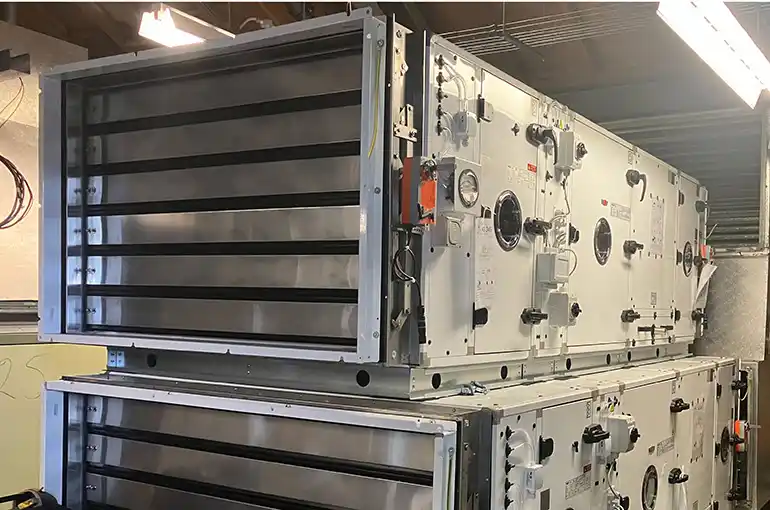 WOLF HTM 03-1 compliant AHU with stainless steel dampers
Energy recovery now sits at the centre of HTM compliant air handling units. Andrew Robinson, Managing Director of Exi-tite Group, outlines how a strong understanding of HTM requirements enables heating, cooling and energy recovery to be integrated within the AHU, drawing on Exi-tite’s experience in delivering compliant, energy-efficient systems without compromising hygiene or control.
Health Technical Memorandum (HTM) 03-01 sets clear expectations for how ventilation systems should be designed, built and maintained in clinical environments. In practice, compliance is driven by headline airflow rates and construction quality, access for maintenance and predictable long-term performance. Air handling units (AHUs) sit at the centre of this, acting as the primary interface between hygiene, environmental control and energy use.
Part A of HTM 03-01 applies to new build and major refurbishment projects and defines the standard to be achieved. While natural and mixed-mode ventilation are encouraged where appropriate, many areas inevitably require full mechanical ventilation. Once that point is reached, the guidance shifts the focus away from air volume alone and towards system integrity and control.
HTM-compliant AHUs must be designed to minimise contamination risk and support routine inspection and cleaning. Requirements around smooth internal finishes, stainless steel or coated panels, low leakage dampers and fully drainable sections are fundamental. These details are not cosmetic. They directly influence whether systems remain compliant and efficient over their operating life.
Plant space is often limited, particularly in existing buildings, and poor access quickly undermines even the best specification. AHUs that cannot be serviced safely or thoroughly become a long-term liability. For this reason, maintainability needs to be addressed at design stage, not left to operation and maintenance teams to resolve later.
Energy recovery as a core design principle
Once these fundamentals are established, energy performance and climate control come into play. HTM 03-01 promotes solutions with the lowest lifecycle environmental cost without compromising hygiene or air quality. Given the long operating hours of mechanically ventilated spaces, energy recovery at AHU level becomes central, with heating and cooling integrated into the air handling system to provide stable temperature and humidity control while reducing overall energy demand.
HTM requires that heat recovery is achieved without any risk of cross contamination. This places airside energy recovery firmly within the air handling system itself, ensuring supply and extract air paths remain fully segregated. When designed correctly, this approach allows energy to be recovered and reused efficiently, improving seasonal performance and reducing overall plant loading while maintaining strict control of air quality.
The effectiveness of energy recovery is closely linked to AHU build quality. Drainage, leakage control and access for cleaning all affect long-term performance. Poorly detailed units not only compromise hygiene but also see recovery efficiency degrade over time. In this context, energy recovery cannot be treated as a bolt-on feature; it must be designed into the AHU from the outset.
Integrating run-around coils, heat pumps and DX
Within HTM-compliant air handling systems, energy recovery is typically achieved using indirect methods that maintain full separation between supply and extract air paths. This can be delivered through run-around coils, DX-based recovery, or a combination of both within the same air handling unit. Each approach allows energy to be transferred without mixing air streams, supporting HTM requirements around segregation and infection control.
Run-around coil systems remain a well-established solution and have increasingly transitioned towards air-to-water heat pump integration, allowing recovered energy to be upgraded and reused more effectively while maintaining full separation between air paths. DX-based energy recovery can also be applied at airside level, using refrigerant circuits to recover and redistribute energy between supply and extract sections, either within a single unit or across multiple units serving different areas.
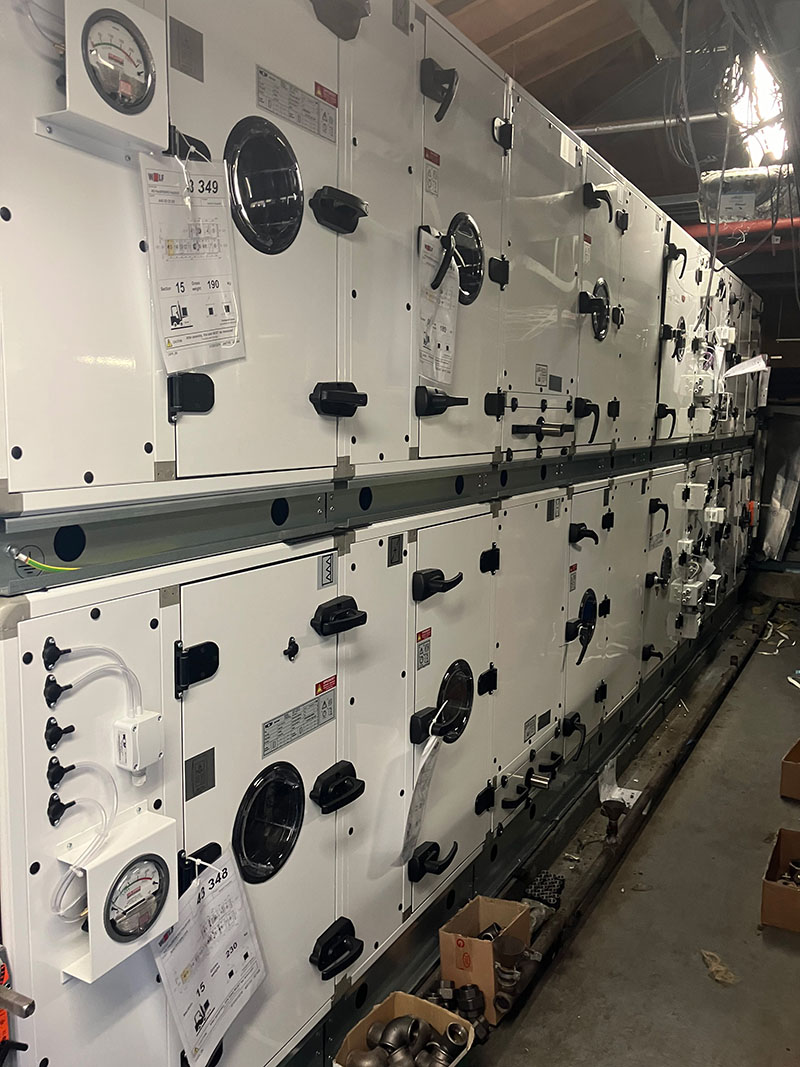
WOLF HTM 03-1 compliant AHU at Antrim Hospital, serving the endoscopy department
In practice, these technologies are not mutually exclusive. In more complex schemes, run-around coils and DX recovery can be applied together within an AHU to maximise recovery potential while maintaining control and resilience. The choice is driven by operating profiles, space constraints and how heating and cooling demands vary across the building, rather than by compliance considerations alone.
This integrated approach is particularly effective in buildings with long operating hours and mixed-use profiles, where simultaneous heating and cooling demands are common. Energy recovered from any airstream can be reused within the same air handling system or redistributed to other units, improving overall efficiency without compromising segregation.
Design, detail and long-term performance
Construction detail remains critical throughout. Where water-based heating coils are used, copper tubes with copper fins are essential to meet hygiene and durability requirements. DX coils must be epoxy coated to resist corrosion and withstand repeated cleaning. These requirements are fundamental where recovery, heating and cooling functions are combined within the same air handling unit and expected to operate continuously.
Controls strategy underpins the success of this approach. Energy recovery, heating, cooling and ventilation control must operate as a coordinated whole. Setpoints, interlocks and failure modes need to be clearly defined and tested, ensuring ventilation is maintained even if individual recovery or conditioning elements are unavailable.
The result is an AHU-led strategy where ventilation, energy recovery and climate control are delivered as a single, integrated system. By designing recovery, heating and cooling into the air handling unit from the outset, systems become easier to operate, simpler to maintain and more predictable in performance over their lifecycle.
From Exi-tite’s perspective, successful projects are those where design intent, equipment selection and integration are aligned from the outset. HTM 03-01 does not restrict innovation, but it does demand discipline. When that discipline is applied at air handling level, energy recovery and climate control technologies can be deployed with confidence, delivering compliant, efficient and resilient systems without compromise.